Wheeled Mobile Robot Hardware


Figure 1. XTENTH-CAR configurations with sensor type and placement variations.
The road car physics and terrain adaptability of the robot facilitate physical evaluation of robotics tasks ranging from Autonomous Vehicle (AV) collision avoidance [3], autonomous racing [4] and navigation in unstructured terrain [5], illustrated in Figures 2-4.

Figure 2. Collision avoidance.
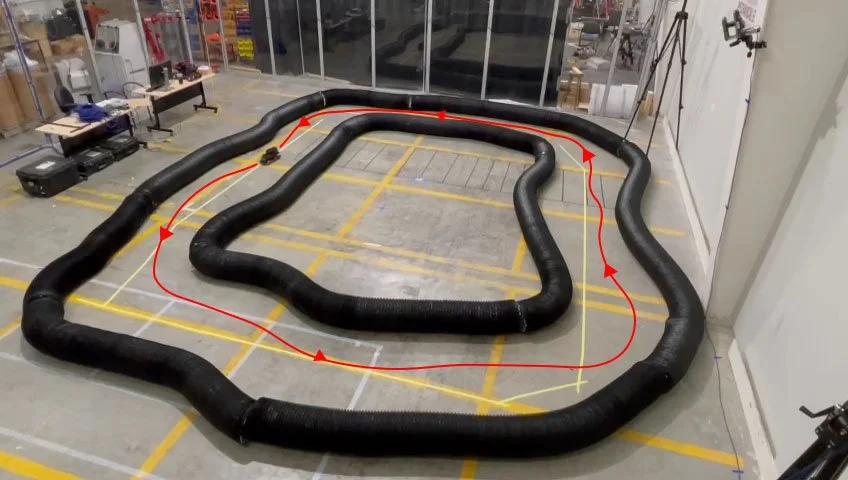
Figure 3. Autonomous racing.
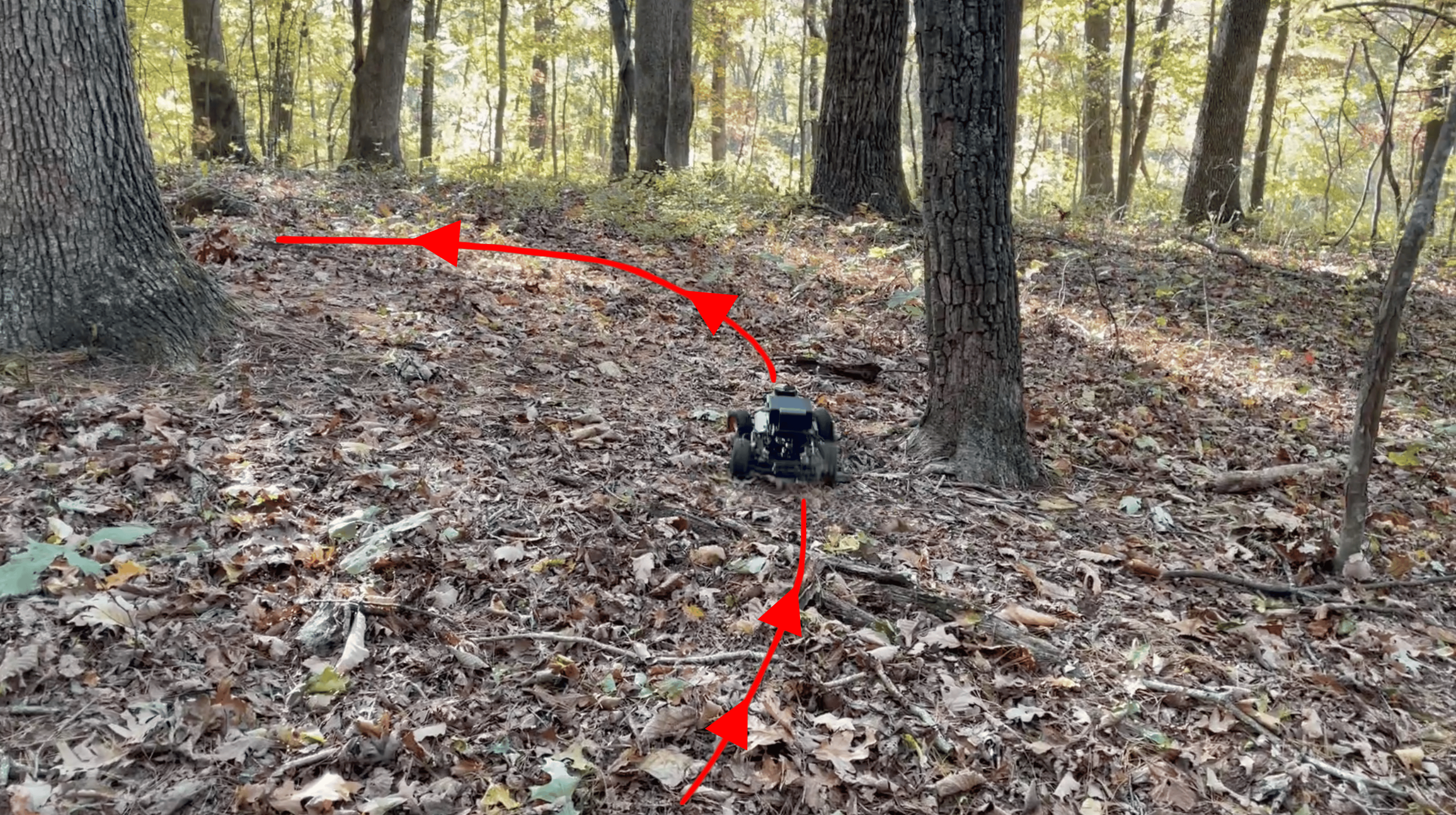
Figure 4. Navigation in unstructured terrain.
Solving robotics requires iterative hardware evaluation of computationally demanding techniques that comprise numerical optimization and Machine Learning (ML) across perception, planning and control that necessitates the interweaving of sensors, actuators and low-latency processing. The cost and complexity are barriers to physical testing, without which factors such as sensor uncertainty, terrain physics and processing latency cannot be precisely identified and circumvented. eXperimental one-TENTH scaled vehicle platform for Connected autonomy and All-terrain Research (XTENTH-CAR) [1] is an accessible, extensible wheeled mobile robot hardware platform governed by identical physics to a full-size on-road vehicle equipped with sensors that comprise 2D LiDAR, stereo and nightvision camera configurations illustrated in Figure 1, and real-time ML processing with a NVIDIA Jetson Orin AGX. A digital twin of the platform facilitates accelerated Artificial Intelligence (AI) training for simulation to reality (sim-to-real) deployment [2].
References
[1] S. Sivashangaran and A. Eskandarian, “XTENTH-CAR: A Proportionally Scaled Experimental Vehicle Platform for Connected Autonomy and All-Terrain Research," Proceedings of the ASME 2023 International Mechanical Engineering Congress and Exposition.Volume 6: Dynamics, Vibration, and Control. New Orleans, LA, USA, Oct. 29–Nov. 2, 2023. V006T07A068. American Society of Mechanical Engineers. (Link) (Preprint)
[2] S. Sivashangaran, A. Khairnar and A. Eskandarian, “AutoVRL: A High Fidelity Autonomous Ground Vehicle Simulator for Sim-to-Real Deep Reinforcement Learning," IFAC-PapersOnLine, vol. 56, no. 3, pp. 475-480, Dec. 2023. (Link) (Preprint)
[3] S. Sivashangaran, V. Dutta, A. Khairnar, S. Gohari and A. Eskandarian, “Autonomous Vehicle Collision Avoidance With Racing Parameterized Deep Reinforcement Learning,” arXiv preprint arXiv:2604.16702, Apr. 2026. (Link)
[4] S. Sivashangaran, A. Khairnar, S. Gohari, V. Dutta and A. Eskandarian, “Physics-Informed Reinforcement Learning of Spatial Density Velocity Potentials for Map-Free Racing,” arXiv preprint arXiv:2604.09499, Apr. 2026. (Link)
[5] S. Sivashangaran, A. Khairnar and A. Eskandarian, “Mobile Robot Exploration Without Maps via Out-of-Distribution Deep Reinforcement Learning," IFAC-PapersOnLine, vol. 59, no. 30, pp. 533-538, Dec. 2025. (Link) (Preprint)